3DMark06 Advanced and Professional Edition Features
3DMark06 includes advanced Shader Model 2.0 and 3.0 graphics tests as well as single CPU, multiple core and multiple processor tests as part of the 3DMark score.
With 3DMark06 Advanced and Professional Editions, you get a comprehensive suite of 3D gaming benchmarking tools. All the tests, settings and options needed to run accurate and dependable performance analysis are included in one easy to use application.
Please note that all the tests and options listed below can only be found in 3DMark06 Advanced or 3DMark06 Professional Editions. Please go to the "Buy it" -page for details of the Basic Edition.
3DMark06 Online Services
The ORB, a searchable online database of benchmark results is an essential part of the 3DMark experience. The ORB lets you compare the performance of your PC with other similar systems by searching through over 27 million results.
From the ORB comparison graphs, you can easily see how your PC's performance could be improved by upgrading to a faster processor, adding memory or installing a more powerful graphics card for example.
Advanced and Professional Edition users benefit from advanced search and won’t see any banner advertising while using the ORB.

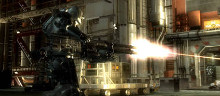
SM2.0 Graphics Test 1: Return to Proxycon
This 3rd person shooter emulation makes use of very complex SM2.0 shaders. Large interior spaces accommodate more characters for lots of action. With 26 total lights, two are directional with one casting CSM (Cascading Shadow Maps), 12 point lights provide fill, most cast shadows using 1024x1924x6 cube depth maps and hardware shadows, some are masked and animated, and finally 12 small spot lights with non-overlapping shadow-maps produce a richly lit and shadowed game scene.

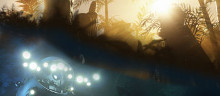
SM2.0 Graphics Test 2 - Firefly Forest
A large outdoor scene is dense with vegetation and grass is dynamically distributed and altered according to the camera's location. A pair of fireflies flit about among animated trees, branches and leaves dramatically highlighting the benefits of cascading shadow maps (CSM) and high resolution shadow-mapped point lights. The scene is lit with one directional light casting CSM to create a moonlight effect. The two illuminated fireflies are shadow-mapped point lights with cube-map masks. A procedural light scattering shader is used for the humid night time sky. Materials have Blinn-Phong reflections using lookups for materials. The ground material has diffuse, diffuse detail, normal and normal details maps added. Rock surfaces have an added specular map. Tree branches are similar to the rock materials but with an added diffuse cube map and no specular or bump map.

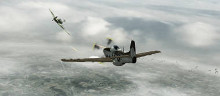
SM3.0 Graphics Test 1 - Canyon Flight
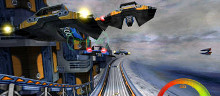
The updated game engine supports extremely complex SM3.0 shaders in this test for exquisite HDR (High Dynamic Range) rendering effects, as well as highlighting the benefit of dynamic shadows. This period style adventure game scene makes extensive use of smooth shadows. A massively complex outdoor canyon and seascape is rendered in very realistic HDR. Sky and atmospheric effects rely on a complex atmospheric light scattering algorithm with cloud blending; adding great depth to distant scene elements. A heterogeneous fog effect creates deep humidity throughout the canyon. Water effects are recreated using HDR reflections and refractions, plus a depth fog is used below the surface, and the water surface is distorted with two scrolling maps and Gerstner wave functions. Smoke and fire particle effects emanate from the airship. Subsurface scattering and a Blinn-Phong shading model with two normal maps and one color map are used for the sea-monster. Strauss shading is used for the captain, crew and airship. The canyon wall material uses three color maps, three normal maps and Lambertian diffuse shading. One directional light, casting CSM is used to create the bright sunlight, producing dramatic dynamic shadows, while showcasing the challenging effect of dynamic shadows on large round shapes.

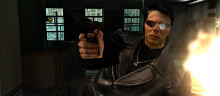
SM3.0 Graphics Test 2 - Deep Freeze
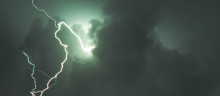
This test emulates a movie-like horror adventure scene and showcases CSM with dynamic long, soft shadows for a striking daytime to night-time transition. As the sun sets, shadows dynamically increase in length for a very realistic effect. For the snow storm, heterogeneous fog and particles with an added diffuse cube map are used. A simple atmospheric light scattering algorithm is used for the sky. A Blinn-Phong shader with two normal maps, one color map and subsurface scattering is used for the snow material. Metallic and other surfaces use the Strauss shading model. One directional light casting CSM recreates the sunlight. By blending a pair of cube-maps, (one diffuse, the other specular) an ambient effect is created.

CPU Tests - Red Valley
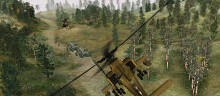
Both CPU tests rely on AI, physics and game logic to generate a multi-threaded workload that can be distributed on multiple processors, cores or even on a single processor. Aegia PhysX library and D* Lite path finding AI algorithm are used to produce demanding CPU loads. Tests are run in a fixed frame rate of 2FPS for more equal CPU loading. Resolution is locked to 640x480 to decrease GFX influence of performance. The shader profile is locked to 2_0 and no dynamic shadows are used.
CPU Test 1:
The test uses a high level of path finding complexity, tight AI synchronization intervals over 40 frames, locked to fixed frame rate of 2FPS with a Shader Profile of 2_0 and a resolution of 640x480.
CPU Test 2:
The test uses a lower level of path finding complexity, lax AI synchronization intervals over 60 frames, locked to a fixed frame rate of 2FPS with a Shader Profile of 2_0 and a resolution of 640x480.